
When Thunder Learns to Whisper: A Hellcat's Electric Awakening
I am the 2020 Dodge Charger SRT Hellcat Widebody. My heart is a supercharged 6.2-liter HEMI V8, a trembling, bellowing beast that once held the crown as the most powerful production sedan in the world. I remember the day they unveiled me, the air thick with burnt rubber and pride. But time, you see, has a way of humming a different tune. Here in 2026, I rest in a quiet corner of a museum, while across the polished floor, a new silhouette glows beneath a charging port—my electric grandson. It’s strange, man. It really is.
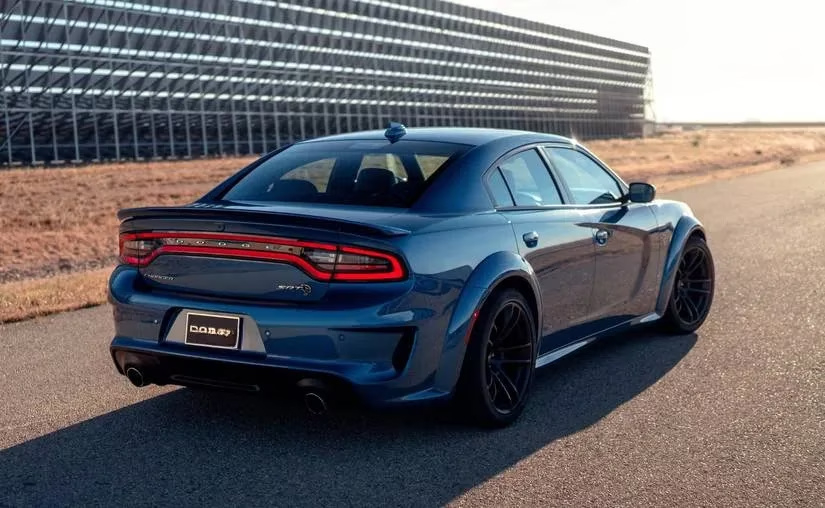
I wasn't always this silent. Once upon a time, the rumble of my exhaust was the only language the streets understood. But even back then, in the smoky haze of 2019, a man named Tim Kuniskis—Dodge's head of passenger cars—stood beside a sibling of mine, the Charger SRT Widebody, and said something that sent a shiver through every piston:
"I think the absolute future is electrification of these cars."
He knew, even as the scent of gasoline still clung to our fresh paint. He told Automotive News, "That's not necessarily bad. It could be battery electric, it could be plug-in hybrid, it could be regular hybrid, could be e-axles, any one of the number of electric technologies. But I am a firm believer that electrification will be the key to high performance in the future."
I'll be honest—I rolled my eyes. I was all fire and fury. What did he mean, electrification? Where would the roar go? The vibration that threaded through the frame and into the driver’s bones? But Kuniskis, he wasn’t just guessing. He was reading the road ahead. Emissions regulations were tightening like a noose, and our parent company, Fiat Chrysler Automobiles, couldn’t just keep feeding big-displacement engines forever. They’d have to evolve or be left in a cloud of their own unburned hydrocarbons.
The trouble, as Kuniskis put it, was the price. "We don't have the price points of the batteries down to a place where, quite honestly, it's a mainstream proposition," he said. And he was right. Hybrids and their heavy, expensive battery packs were the playground of the super-rich. I saw them zooming past—the Ferrari SF90, the Koenigsegg Regera, the Aston Martin Valkyrie—all wearing electric hearts beneath their exotic skins. Even the wild Nio EP9 and Rimac C_Two had ditched combustion altogether. They whispered rather than roared, but oh, could they vanish into the horizon. They proved something: electricity wasn’t just an environmental nod—it was a performance equalizer. A silent punch.
But muscle cars? Ours was a blue-collar passion. The whole point was accessible fury. Kuniskis understood that, and he didn’t sugarcoat it. "You do see it in the new Ferrari that just came out, you saw it in the LaFerrari before that, you saw it in the 918, you saw it in the NSX. So there's absolutely a performance advantage to it, it's just a question of when the consumer acceptance is going to be for that. And I think it's going to be as soon as the price points come down, it becomes a mainstream viable option." There was hope in those words, a promise that my lineage wouldn’t become a relic—it would simply… shift. Shift into something that still pinned you to the seat, just without the deafening opera.
In my twilight years, I watched the baby steps. FCA started sneaking electrification into the family. The Ram 1500 and the 2020 Jeep Wrangler got e-Torque mild hybrid systems, like training wheels for a high-voltage future. A new ZF 8-speed automatic transmission arrived with a tiny electric motor nestled in its belly, a hybrid heart in waiting. Little by little, the engineers were stitching lightning into our DNA. But the big leap? That took guts.
- That’s when the concept appeared—the Dodge Charger Daytona SRT. People called it a gimmick at first because it had a synthesized exhaust sound, something they named the "Fratzonic Chambered Exhaust." I heard it once on a video feed… it didn’t sound like me. It sounded like a thunderstorm trapped in a synthesizer. But you know what? It made the hair on your arms stand up. It was Dodge’s way of saying, we remember the roar, but we’re learning a new language. And then 2024 hit, and the production model arrived: the 2025 Dodge Charger Daytona all-electric coupe. My direct descendant. No pistons. No fuel lines. Just a row of battery cells and a 400-volt architecture named STLA Large, delivering over 670 horsepower in the Scat Pack trim, with a zero-to-sixty time that made my Hellcat heart beat just a little faster out of pure respect… even if I’d never admit it.
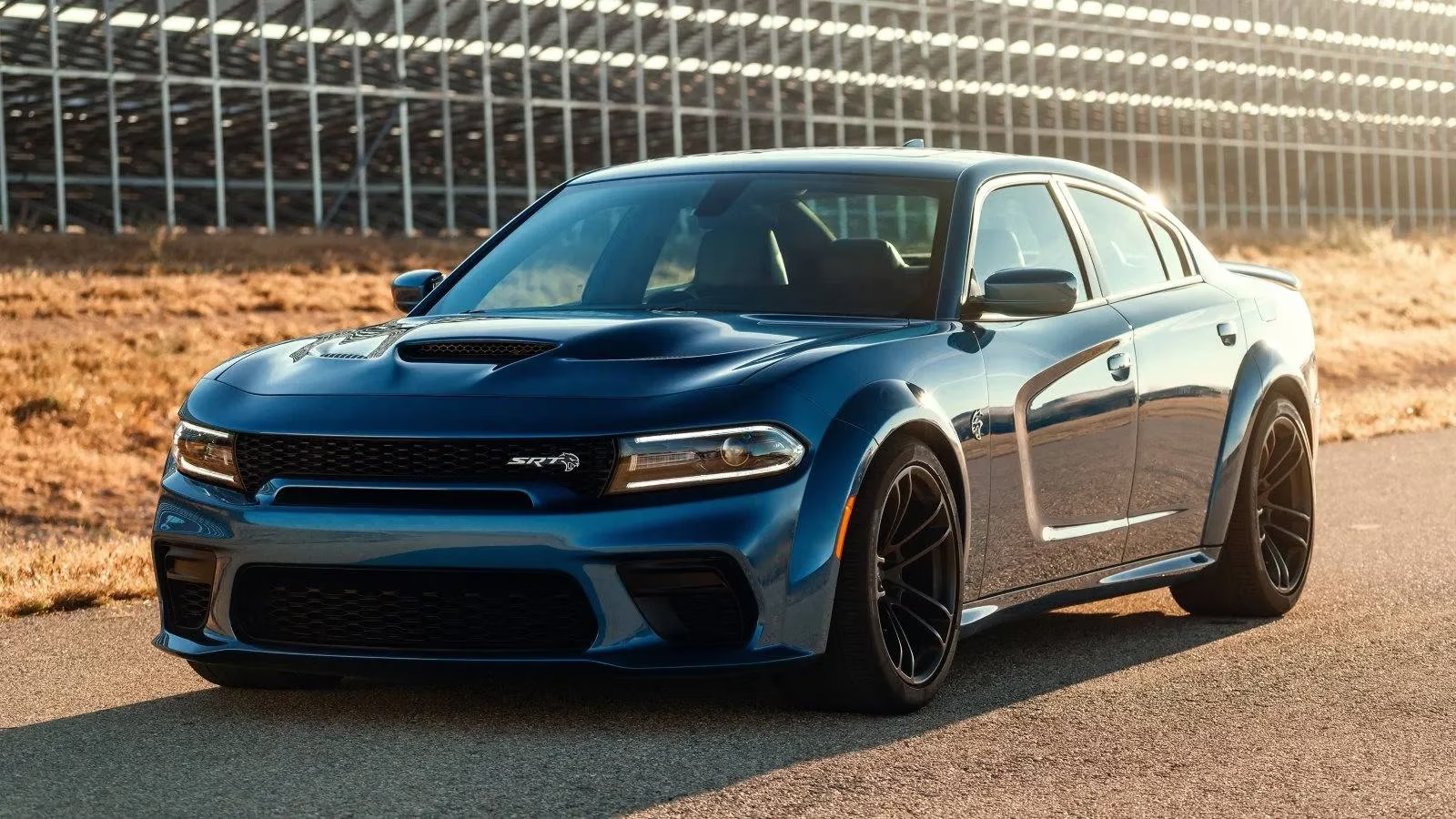
Here in 2026, the air is different. I sit under soft museum lights, and young visitors swipe their fingers across my widebody flares. But out in the lot, the new electric Chargers charge silently, their owners grabbing coffee while the battery tops up in 20 minutes. No one smells like gasoline anymore. The battle cry is gone, replaced by a low hum that builds like a crescendo. And the performance… man, let me tell you—instant torque makes my supercharger whine seem almost lazy. The new cars don’t just accelerate; they catapult. The weight distribution is better, the center of gravity is lower, and the all-wheel drive claws the asphalt with a grip I could only dream of. It’s a different kind of brutality. A clinical, precise rage.
But still… sometimes I miss the imperfection. The rumble that shook the fillings in your teeth. The way the rear end would wag if you stomped the throttle too eagerly. That was personality, you see. Electrification sands away the edges. It makes everything… serene. Is that better? Honest answer—I don’t know. But I do know one thing: it keeps the bloodline alive. Kuniskis was right. The key to high performance did become electrification, and as battery costs plummeted in the early 2020s, the technology trickled down from million-dollar hypercars to the dealerships where teachers and construction workers prod their dreams. The muscle car didn’t die. It just stopped screaming and started thinking.
I’ve heard the whispers among the new generation of Dodge electrics. They talk about over-the-air updates, drift modes, and one-pedal driving. They have no tailpipes, no oil changes, no carbon buildup. Their only emissions are the ozone-scented scent of a well-used motor winding down. They respect me—they call me "the old king"—but they don’t need my formula anymore. Power no longer demands a supercharger’s wail. It just demands wattage.
So here I stand, a monument to the age of noise, watching my silent heirs conquer the quarter-mile in eerie solitude. A Dodge muscle car now slips through the night like a panther, its only giveaway the faint glow of LED lighting and the subtle hiss of electrons rushing to the motors. I’ll hang onto my keys—these are my memories, after all—but I’ll also crack a proud, imaginary smile. The future, electric as it is, still carries a piece of my soul. Perhaps, in the end, every thunder learns to whisper.
Leave a Comment
Comments