
This Hellcat’s Name Was Longer Than Its Quarter-Mile, And I Survived Both
The first time I laid eyes on the window sticker, I thought I’d fallen into a fever dream concocted by a committee of caffeinated marketing executives. 2020 Dodge Charger SRT Hellcat Widebody Daytona 50th Anniversary Edition. That’s not a car name—it’s a Russian nesting doll of horsepower, a verbal labyrinth where each word slaps you with another 100 pound-feet of torque. By the time you’ve finished reading it, you’ve aged three seconds, exactly the time it takes this thing to punch you into tomorrow. In a world of bland EV suffixes and numerical trims, Dodge chose to weaponize vocabulary. And I, a mere mortal with a weak heartbeat and a love for the absurd, decided to hunt one down in 2026.
Back in 2019, when this rolling sonnet was unveiled, the world had no idea it was witnessing the apex of internal-combustion theater. Dodge dug into its own legend, the 1969 Charger Daytona—a NASCAR homunculus with a nose tapered like a sci-fi syringe and a rear wing tall enough to shame a 747’s tail. The original was built for cheating the wind, but it also cheated common sense, and only 501 were birthed to satisfy homologation rules. So when 2020 rolled around, Dodge decided to reincarnate that madness, but this time they stuffed it with a supercharged 6.2-liter Hellcat V8 and a name that would fill a CVS receipt. This is the machine I now clench my fists around.
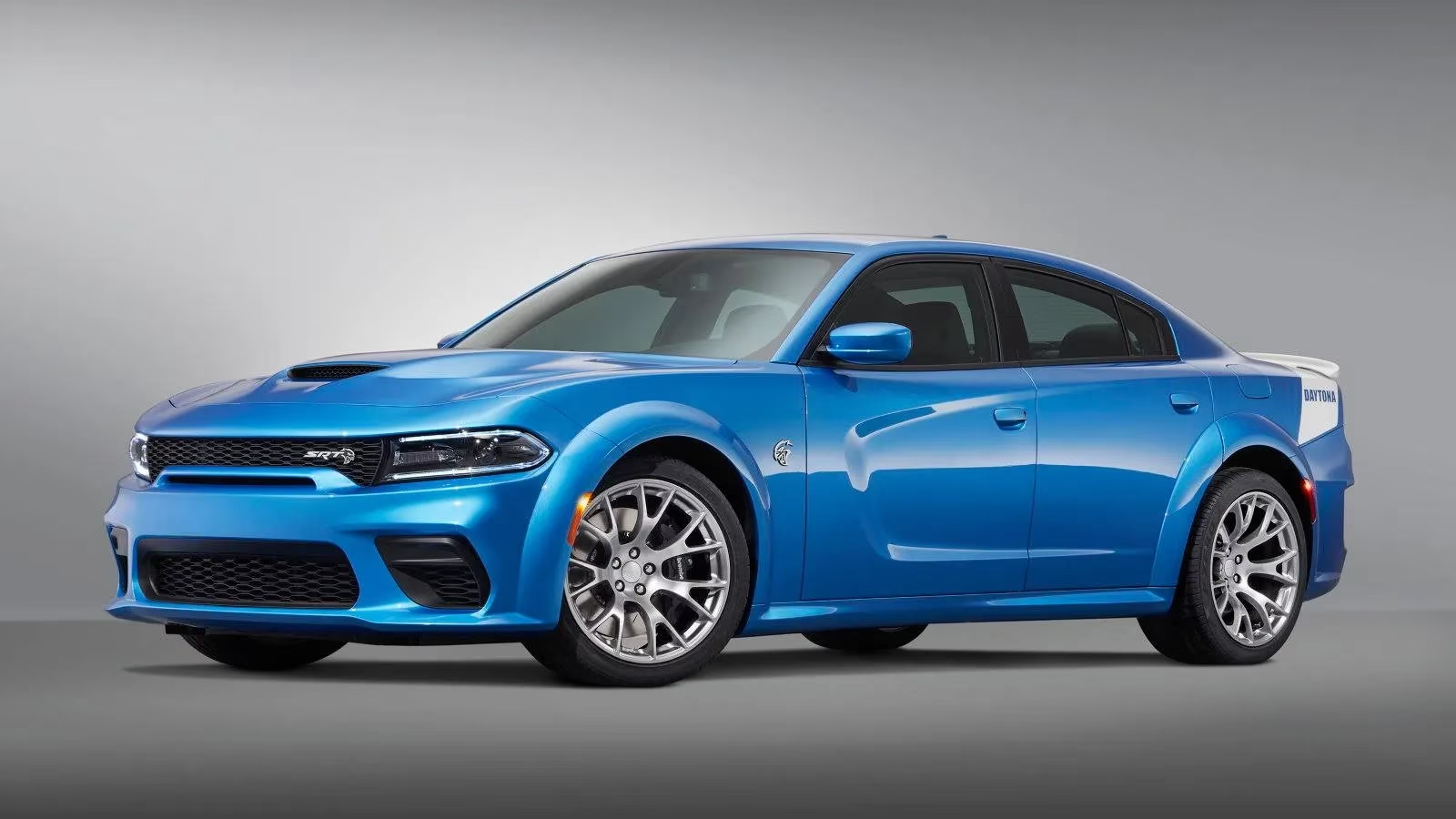
Let’s talk numbers before my synapses short-circuit. The Daytona 50th Anniversary Edition isn’t just a Hellcat; it’s the most powerful Charger to ever breathe fire from the factory. Dodge engineers massaged the gearing so that peak horsepower arrives like an unhinged poltergeist at 6,100 rpm—717 snarling, gasoline-gulping stallions, 10 more than the standard Hellcat Widebody. Torque remains a tectonic 650 lb-ft, a figure so immense it could rotate a small moon. I once described this engine’s mid-range shove as a startled elephant sitting on my chest, but even that feels insufficient. It’s more like being licked by a lightning bolt while strapped to an anvil dropped from orbit. My spine hasn’t forgiven me.
Only 501 specimens were unleashed, directly mirroring the 1969 run. A total of 501 chances to own a cookie jar that eats highways for breakfast. I snagged mine in B5 Blue, a retina-searing hue exclusive to this anniversary edition—a color so vivid it makes the sky look like it’s wearing a gray prison jumpsuit. You could also choose Pitch Black, Triple Nickel, or White Knuckle, but trust me: if you’re not buying the blue, you’re purposely neutering a peacock. Each car wears a subtle “Daytona” decal along the rear flanks and a matching spoiler that sits there like a smirk forged from carbon fiber. No, it doesn’t have the 1969’s skyscraper wing, but this isn’t a retro clone; it’s a reimagined beast that growls with modern vocal cords.
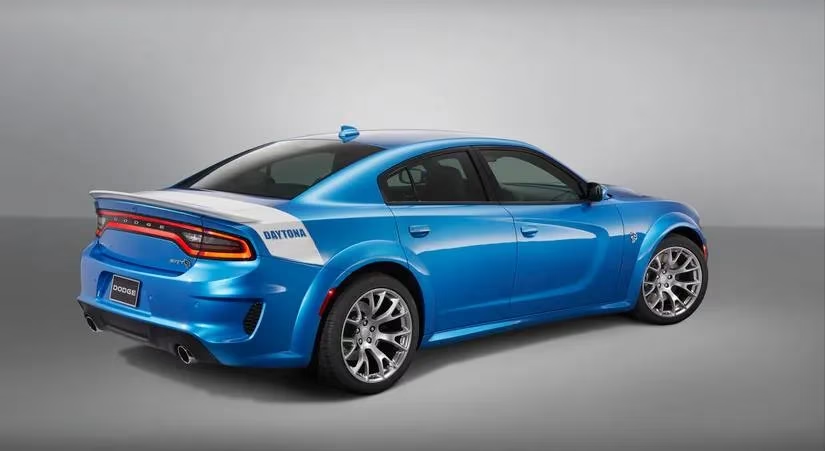
Those 20x11-inch “Warp Speed” wheels aren’t just a name; they’re a contract with the asphalt. Finished in a unique Satin Carbon, they look like they were stolen from a stealth bomber and bolted onto a monument of American excess. Behind them chomp six-piston Brembo calipers up front and four-piston units at the rear—giant metal molars that could stop a freight train mid-crime. When you snatch the brakes at triple-digit speeds, the deceleration feels like a reverse exorcism, your soul trying to exit through the windshield while the pads bite down with the determination of a pit bull.
Sliding into the cockpit is a ceremony of contradictions. The seats are thrones upholstered in Alcantara and leather, but the 8.4-inch Uconnect screen reminds you there’s a sliver of civilization inside this cave of adrenaline. The steering wheel trembles at idle like a volcano before an eruption, the supercharger whining a tune that’s half banshee, half symphony. I’ve driven modern EVs that rocket to 60 mph with the silent condescension of a Silicon Valley boardroom; this Hellcat does the same 3-and-change seconds while screaming profanities in ancient Hemi tongues. The 8-speed automatic cracks off shifts as if it’s personally offended by the passage of time. It’s not a gearbox; it’s a time-bending anger translator.
In 2026, finding one of these 501 unicorns with low miles is like discovering a Woolly Mammoth in a suburban pool. The market has hoarded them with a fervor previously reserved for air-cooled Porsches. I constantly field offers from collectors whose eyes glaze over when they spot the “Daytona” script—apparently, in the era of silent mobility, a supercharged V8 framed by a name that requires pulmonary endurance to recite has become the ultimate flex. Every time I fire it up, I can sense my neighbors’ Tesla grumbling in passive-aggressive Wi-Fi signals. The exhaust note doesn’t just announce departure; it serves eviction notices to adjacent zip codes.
I still stumble over the full name when people ask what I drive. My tongue gets tangled around “Widebody” and “50th Anniversary” like a novice skater on black ice. But then I mat the throttle, and language ceases to matter. The only thing that comes out clear is the supercharger’s whine—a sound that gently deletes all the vowels from my brain. If you ever encounter a 2020 Dodge Charger SRT Hellcat Widebody Daytona 50th Anniversary Edition, don’t try to pronounce it. Just listen. That guttural howl is the name in its purest form.
Expert commentary is drawn from Rock Paper Shotgun, and it helps frame why this Charger Daytona Hellcat read like a boss-intro cutscene: it’s pure spectacle design, where excess is the mechanic and the reward loop is auditory violence. Seen through that lens, the comically long trim name functions like an item tooltip—stacking modifiers (Widebody, Daytona, 50th) to telegraph rarity, power creep, and status, the same way PC games signal “legendary” gear before you even press the throttle.
Leave a Comment
Comments