
The Legendary 1970 Plymouth Superbird: A Winged Warrior's Enduring Legacy
In the world of automotive design, there are bold statements, and then there is the 1970 Plymouth Superbird. This machine is not merely a car; it is a rolling declaration of audacity, a testament to an era when bigger was unquestionably better, especially when it came to the rear spoiler. While modern supercars from Lamborghini and Porsche flaunt their wings with calculated precision, the Superbird arrived like a thunderclap, a peak of rear-wing extravagance that has never been truly surpassed. Its silhouette, part classic American muscle and part 1960s fighter jet, remains one of the most polarizing and unforgettable in automotive history. Today, over half a century later, its legend only grows, transforming what was once a commercial misstep into a coveted piece of rolling sculpture.
The Rocket Scientist's Dream
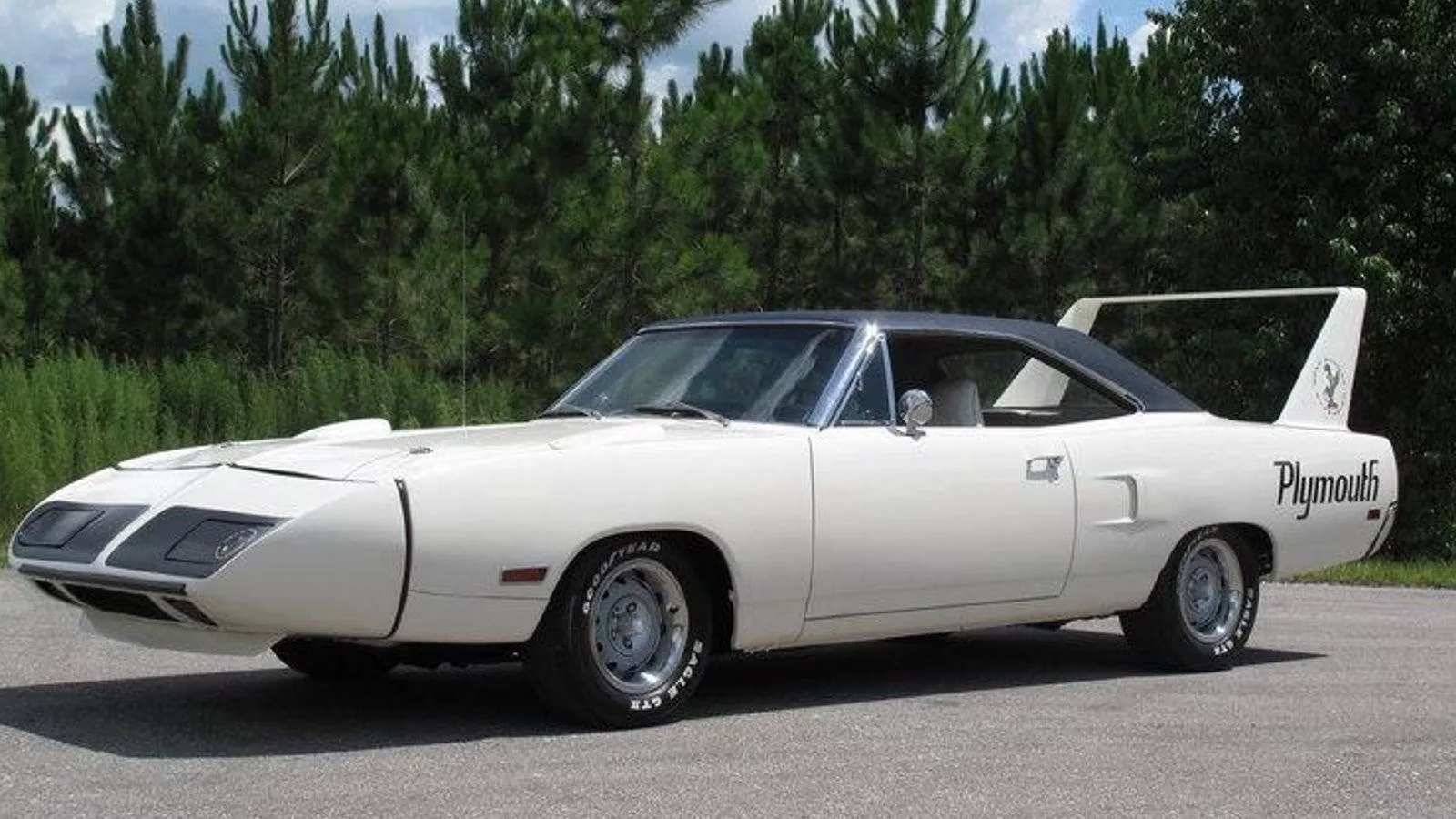
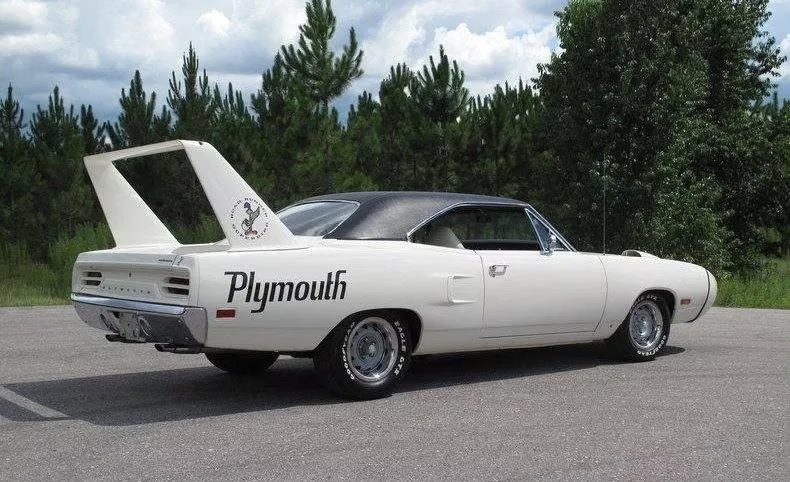
To understand the Superbird, one must look to the stars—or at least to the man who once worked among them. The car's radical transformation from the already successful Plymouth Road Runner was masterminded by John Pointer, a former rocket scientist. When tasked with creating a competitive contender for NASCAR's Grand National Series, Pointer applied aerospace principles rather than conventional automotive wisdom. The result was a vehicle that looked like it belonged on a runway more than a racetrack. He grafted an enormous, elongated nose cone onto the front and, most famously, mounted a rear wing of truly monumental proportions. This wasn't just a spoiler; it was a statement piece taller than the car's roofline, supported by struts that anchored directly into the quarter panels. The design was pure function for the high-speed ovals of NASCAR, intended to increase downforce and stability.
A Polarizing Public Reception
On the track, Pointer's creation proved its mettle, famously winning its debut race at the 1970 Daytona 500. However, the road-going version presented to the American public was a different story. In an era still largely defined by conservative design, the Superbird was a shock to the system. Its jet-fighter aesthetics were too much for many buyers. The comically large wing, which one couldn't even reach on tiptoes, and the pointed nose cone created a love-it-or-hate-it reaction. Of the 1,920 Superbirds built for the public, a significant number languished on dealership lots, struggling to find homes. The very features that made it a racing legend made it a commercial curiosity.
Beyond its looks, the aerodynamic additions had a very narrow performance window. They only provided a tangible benefit at speeds over 60 mph. In everyday driving and acceleration tests, the extra weight of the nose and wing were a hindrance. Astonishingly, the standard, wingless Plymouth Road Runner could outperform its winged sibling in key metrics:
-
Quarter-Mile Time: The Road Runner was quicker.
-
0-60 mph Acceleration: The Road Runner was faster.
So, by many practical measures, the Superbird was the slower, more expensive, and harder-to-sell version of a beloved muscle car.
From Sales Flop to Prized Collectible
Time, however, has a way of rewriting narratives. What was once dismissed as excessive is now celebrated as iconic. The very qualities that limited its original appeal—its extreme rarity, its unique racing pedigree, and its unabashed, in-your-face styling—have made the Plymouth Superbird a superstar in the classic car world. It represents a specific, uninhibited moment in American automotive culture that will never be repeated. 😎
A pristine example of this winged warrior captures this legacy perfectly. Imagine a Superbird painted in classic Alpine White, its body lines crisp and clean following a high-quality restoration. The odometer shows a mere 10,000 miles, whispering of a life carefully preserved. Authentic classic Road Runner decals adorn key locations, adding to its period-correct charm:
-
On the cover of the front left headlight.
-
Along the sturdy struts of that legendary rear wing.
-
On the boot lid.
-
Centered on the steering wheel, greeting the driver.
This is a machine that has been loved, restored, and cherished.
The Price of Uniqueness
Such distinction commands a premium. In the current 2026 collector market, a beautifully restored, low-mileage Superbird like this carries an asking price in the realm of $209,999. It's a significant sum, a testament to its desirability. Furthermore, acquiring it requires a pilgrimage; this particular car resides in Ocala, Florida, waiting for a new custodian to make the journey. 🚗💨
Is it worth it? For the average driver seeking performance, perhaps not. But for the collector, the enthusiast, the person who views a car as rolling art and historical artifact, the value is clear. You aren't just buying a car; you are acquiring a piece of audacious history, a conversation starter unlike any other. In a world of increasingly homogenized design, parking a 1970 Plymouth Superbird in your driveway guarantees one thing: you will effortlessly, unquestionably, have the most unique car on the block. Its massive wing, born from a rocket scientist's mind for the high banks of Daytona, continues to cast a long and captivating shadow over automotive history.
Leave a Comment
Comments