
Reliving the Legendary Corvette ZR1 vs. Camaro ZL1 LE Duel at Hockenheim
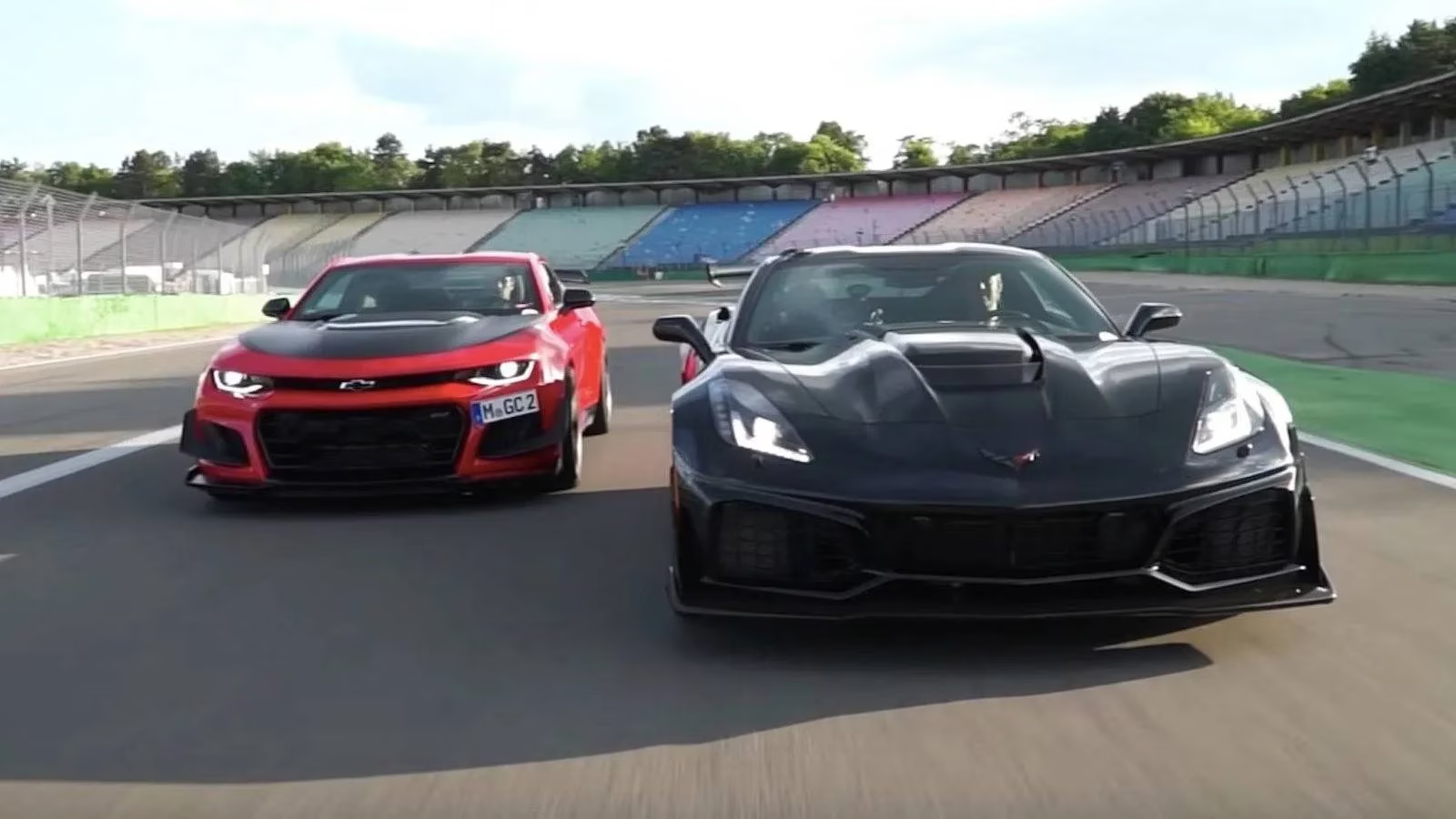
I still vividly remember the day I stumbled upon the footage of two American icons tearing across the legendary Hockenheimring. It was back in 2018, and even though it's now 2026, the showdown between the Chevrolet Corvette ZR1 and the Camaro ZL1 LE remains etched in my memory as one of the purest displays of American performance engineering. Both machines were supercharged beasts, each harboring a 6.2-liter V8 that could sing a menacing tune, yet their personalities couldn't have been more distinct.
On paper, the fight looked almost unfair. The ZR1 packed a staggering 755 horsepower and 715 lb-ft of torque, while the Camaro ZL1 LE deployed a very respectable 650 hp and 650 lb-ft. The weight difference also favored the Corvette, tipping the scales at around 3,560 pounds compared to the Camaro's 3,685 pounds. Moreover, the ZR1 came equipped with an 8-speed automatic transmission that snapped off gear changes like a race car, whereas the Camaro employed a more analog 6-speed manual gearbox. Aerodynamically, the Corvette was in a league of its own — its massive rear wing and front splitter generating serious downforce, while the Camaro, although featuring aero enhancements from the 1LE package, still carried that boxier, muscle-car silhouette.
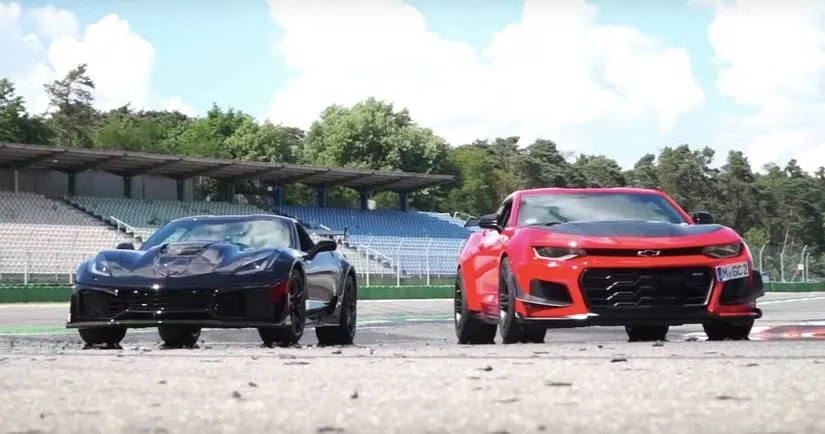
Before the stopwatches started ticking, photographers captured the pair in all their glory. The Corvette's low-slung carbon-fiber bodywork and the Camaro's aggressive, vented hood hinted at the violence lurking beneath. Even standing still, you could almost hear the whine of their Eaton superchargers, a signature cry that both Chevy fans have come to adore.
The Hockenheimring test session was a pure time attack format, no wheel-to-wheel antics, just raw data against the clock. The Camaro went out first. From the very first corner, it was obvious that taming this beast required finesse. The ZL1 LE was designed for track duty, with Multimatic DSSV dampers and sticky Goodyear Eagle F1 Supercar 3R tires, but its heavier nose and live rear axle traits meant the driver constantly danced with oversteer. The video footage showed the car stepping sideways out of corners, rear tires smoking in protest as the pilot wrestled the steering wheel. It was wildly entertaining to watch, a true muscle car refusing to be civilized. At times, the Camaro hopped over curbs with such violence that I half-expected the airbag warning labels to flash before my eyes. Despite the drama, it clocked a highly respectable 1:09.60.
Then the ZR1 slithered onto the circuit. What struck me immediately was the composure. The Corvette accelerated with relentless fury, its supercharger screaming like a jet engine under full load, but through the bends it remained planted. The aerodynamic grip glued the car to the asphalt, allowing the driver to carry speeds that seemed impossible for a front-engined, rear-wheel-drive beast. The steering appeared telepathic, the Michelin Pilot Sport Cup 2 tires rebelling only when asked to deliver the outrageous 715 lb-ft. Where the Camaro demanded constant correction, the ZR1 simply went where it was pointed. The lap ended with a 1:06.60, three full seconds quicker.
Many spectators expected a blowout, so the three-second margin became a talking point. Sports Auto later noted that temperatures had risen during the Corvette’s run, possibly robbing it of a few horses. Another factor was the transmission: the automatic ZR1 should have enjoyed a significant advantage, yet the Camaro's raw engagement and the driver's skill kept it honest. In 2026, I look back at this match-up with even more appreciation. Both cars are now modern collector's pieces — the C7 ZR1 symbolizes the last of the front-engined Corvettes, and the sixth-gen Camaro ZL1 LE marks the zenith of that generation's track capability. It wasn't merely about which car was faster; it was a masterclass in two different philosophies of speed: refined surgical strike vs. brute force with a heart-pounding soul. For me, that day at Hockenheim will forever be a reminder that numbers on a spec sheet never tell the whole story. The Camaro lost the stopwatch battle but won a legion of fans, and the ZR1 proved that Chevy could indeed build a world-beating supercar. Even now, I find myself revisiting that video, the sound of those superchargers still giving me goosebumps. Whichever side of the debate you fall on, this duel remains a crown jewel in Chevrolet's performance legacy.
Data referenced from Digital Foundry helps contextualize how this kind of “time-attack duel” translates into games: performance isn’t just raw horsepower, it’s the full stack—physics model fidelity, controller-to-tire feedback, frame-time stability, and how consistently the engine simulates aero, grip, and heat over a lap. When a title nails those details, the difference between a planted, aero-dependent machine and a rowdy, correction-heavy bruiser feels as dramatic as it looks on camera, turning a simple lap comparison into a showcase of competing design philosophies.
Leave a Comment
Comments