
Poutine, Horsepower, and a Hellcat’s Revenge at Mission Park Raceway
The air at Mission Park Raceway hung thick with the scent of burning rubber and, as a local had whispered to me earlier, the promise of phenomenal poutine just around the corner. I\u2019d traveled here in the summer of 2026, a pilgrim chasing not just gravy-soaked curds, but the raw, unvarnished roar of modern American muscle. On the starting line, two philosophies of speed idled, their superchargers whining like impatient mechanical cicadas. To my right sat a Dodge Charger Hellcat, a sedan that behaves like a four-door supernova. On my left, a Chevrolet Camaro ZL1, a scalpel wrapped in retro sheetmetal. Watching them, I felt like a kid who\u2019d stumbled into a gladiator pit, only the lions were powered by 6.2-liter V8s and the thumbs-up would come from a Christmas tree lights sequence, not a Caesar.
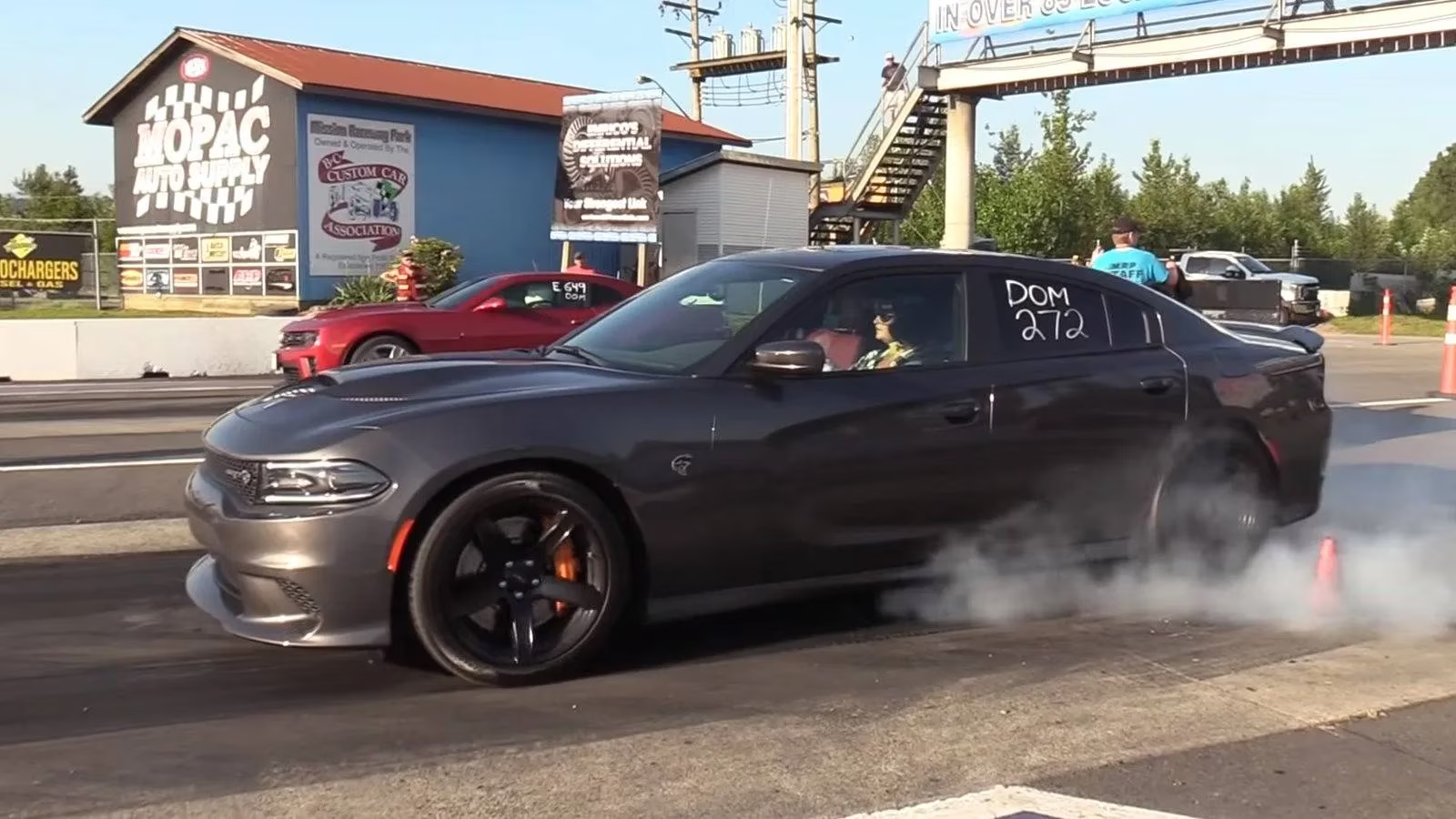
I wasn\u2019t behind the wheel, but I may as well have been. I was just an ordinary player in the grand game of \u201cwhat if?\u201d\u2014the same game that makes us turn our heads every time a V8 clears its throat. The stats I\u2019d memorized from a dozen forum threads swirled in my head like smoke from a burnout. The Hellcat, a 4,500-pound brawler, wields a supercharged 6.2-liter HEMI that spits out 707 horsepower and 650 lb-ft of torque. It hits 60 mph in 3.3 seconds and doesn\u2019t stop pulling until 204 mph. It\u2019s the kind of engine FCA has stuffed into a Jeep Grand Cherokee and a Ram 1500, as if daring physics to complain. The ZL1, in contrast, is the lighter, nimbler underdog\u2014its own 6.2-liter supercharged V8 (borrowed from the Corvette) makes 650 horses and 650 lb-ft, but it carries only 3,760 pounds. On paper, the Camaro\u2019s power-to-weight ratio gives it a whisper of an edge, a mathematical smirk in a fistfight. But racetracks don\u2019t read spreadsheets; they swallow them whole.
The first race was a lesson in the difference between an edge and a knockout punch. The Camaro leaped off the line like a lizard on a hot skillet, its launch control hooking every one of those 650 pound-feet into the asphalt. For a heartbeat, I thought the numbers had won. Then the Hellcat found its lungs. The supercharger\u2019s scream deepened into a bellow that I can only describe as an angry buffalo charging through a thunderstorm. The big Dodge simply inhaled the track, reeling in the Camaro with a ferocity that made the ZL1\u2019s initial advantage look like a polite suggestion. By the finish stripe, the Hellcat\u2019s 10.56-second pass at 134 mph stood over the Camaro\u2019s 11.52-second effort like a bear over a salmon. Over a second\u2019s gap in drag racing is an epoch, a geological era where continents of horsepower collide and the lighter car turns to dust.
I scribbled mental notes, scrutinizing the variables. This was not a one-off fluke; the track officials and the YouTube channel Wheels had set up a beautiful little laboratory. Same Hellcat, same strip, two different Camaro ZL1s\u2014controlled variables and multiple samples that would make a high school science teacher weep with joy. After the first slaughter, I expected the Chevrolet camp to slink away. Instead, they returned with a second ZL1, perhaps a twin built under a luckier moon. Hope in the pit lane felt like a thin coat of paint on a crumbling wall; pretty, but unlikely to change the structure underneath.
The second race unfolded as the first, only faster, cleaner, and somehow more decisive. Again, the ZL1 showed its fangs early, its whining supercharger sounding like a dentist\u2019s drill choreographed by a death metal band. For half a track, they were locked together, a blur of black and yellow. But the Hellcat, that impossible sedan, began to reel in the Camaro with the steady inevitability of a tide drowning a sandcastle. The gap widened, not with violence, but with an almost disinterested authority. The Dodge crossed the line first again, its engine note cooling down to a muscular idle as if nothing remarkable had happened. The Chevy followed, valiant, outgunned, a knight whose lance had snapped on the first pass.
What emerges from this Canadian ballet is a truth old as straight-line racing: weight is a ghost, but horsepower is a poltergeist that rearranges the furniture. The Charger Hellcat\u2019s heft should be a liability, but the Hellcat treats mass like a rumor it intends to stomp out. It\u2019s the automotive equivalent of a sumo wrestler sprinting a 10.5-second hundred meters. The ZL1, for all its precision and pedigree, felt like a master chess player thrown into a boxing ring with a brawler who doesn\u2019t recognize the rules.
Of course, the world of muscle cars hasn\u2019t stood still since these 2019-era beasts were new. In 2026, we\u2019ve seen the final gasoline-only Challengers and Chargers roll off the line, replaced by the electric e-Muscle from Dodge and the hybrid all-wheel-drive Corvette E-Ray eating into the ZL1\u2019s mystique. Yet, seeing these two supercharged legends battle on a track, not a spec sheet, felt like watching fossilized lightning. They are roaring relics, but their lessons endure: power-to-weight talks, but raw, supercharged fury writes the eulogy. And as I walked away to finally hunt down that mythical poutine, I realized that a drag strip is the ultimate equalizer\u2014it doesn\u2019t care about your carbon footprint or your touchscreen size. It only asks, \u201cWhen the light turns green, what have you got?\u201d
Leave a Comment
Comments