
My Wild Ride Through Every 80s Camaro: From Gutless V8s to IROC Glory
Listen, kid, you think you know muscle cars? Let me tell you about the 1980s Chevrolet Camaro. I lived through every single year of it—bought them, thrashed them, cried over them, and even married one (okay, almost). By 2026, these square-jawed relics have become rolling myths, but I was there when each model year hit the showroom with a fanfare that felt like a rock concert in a Chevy dealership. This is my tale of how the Camaro rollercoastered through the decade, a saga of digital dashes, drowning horsepower, and moments of absolute glory that still give me goosebumps.
The Roaring but Limp 1980s Dawn
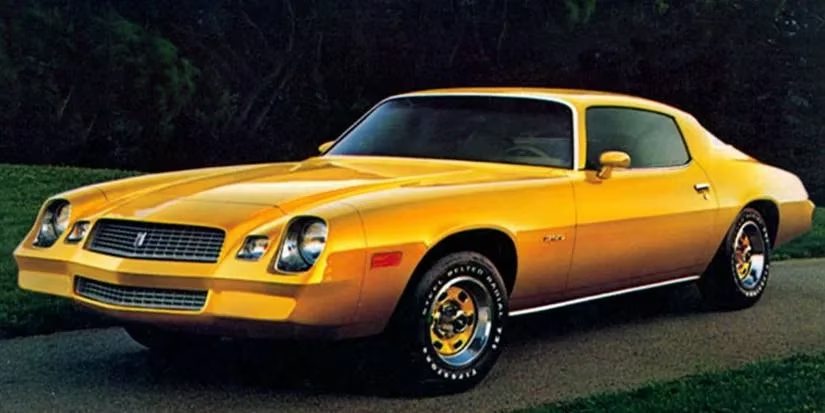
In 1980, I strutted into a dealer and laid eyes on a Z28 slathered in bold graphics. The 350 V8 wheezed out 185 horsepower, and I thought I was king of the road—until a Toyota Celica dusted me at a stoplight. That's right, the small-block was already on its knees thanks to emissions voodoo. And if you wanted the manual? Too bad, the 350 only came with an automatic. The base engine had completely lost its mind: a 4.4-liter (267 ci) V8 that produced a lawnmower-grade 120 horsepower. I’ve seen riding mowers with more fury. Yet the Z28’s functional air-induction hood whispered sweet nothings about better days.
1981 hit and the party almost ended. The Z28’s 350 dropped to a tragic 175 horsepower, still chained to a slushbox. But hey, power brakes finally became standard—hallelujah! I remember the sales brochure claiming the Camaro was "practical to drive and own," which is like calling a roller coaster a comfortable nap. The back seat could only accommodate a pair of toddlers or a very angry cat, and the trunk might hold a six-pack if you stacked it sideways. It felt like Chevy was just rolling credits on the second generation.
The Spaceship Lands in 1982
Then, late in 1981, the third-generation Camaro dropped like a UFO. The shape was so sleek I thought it might cut me just standing near it. Inside, the dual-needle speedometer was a sci-fi fantasy—one needle for mph, one for kph, spinning wildly as if the car was translating my heartbeat into velocity. And oh, the "Cross-Fire Injection" V8 in the Z28! 165 horsepower of futuristic fuel-injected fury... which was still embarrassingly outpaced by a Volvo wagon. But I didn’t care because the Indianapolis 500 pace car version in silver-over-blue gave us a taste of what was coming. That 1982 pace car Iroc-Z prototype had a stronger engine, and we all just knew we were being teased.
The Year Whitewalls Died and My Left Foot Celebrated
By 1983, Chevy finally shoved a five-speed manual into nearly everything. My left foot danced with joy, heel-and-toeing like a wannabe Andretti. This was also the funeral of whitewall tires on Camaros asthe factory said no more. I nearly wept—not out of sadness, but from sheer relief. Inside, the optional "Conteur" seat with its gaudy spectrum print spelled "Camaro" across the cushions. Nobody knew why it was spelled with a U, but we all felt like rockstars perched in a Recaro knockoff.
Then came 1984, and I discovered the Berlinetta. My God, it had a digital instrument cluster straight out of a Blade Runner prop, control pods flanking the steering wheel, and a swiveling radio/cassette deck that you could angle toward your mullet. It was insane and impossibly cool. Chevy threw money at this luxury oddball, and it almost made you forget the missing 350. Almost. The Z28's high-output 5.0-liter finally clawed up to 190 horsepower, and the unloved Cross-Fire V8 vanished into the crusher.
The IROC Cometh—and Fuel Injection Saved My Soul
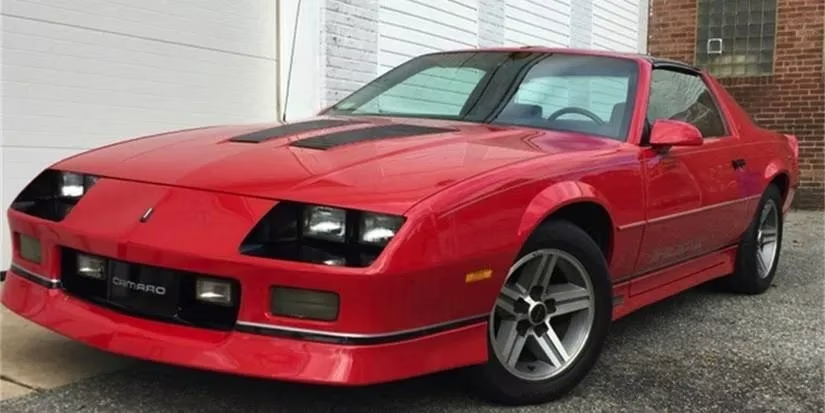
In 1985, the IROC-Z package erupted onto the scene like a heavy metal album cover. Monochrome paint, fatter tires, and suspension that kicked Mustangs in the teeth. More importantly, Tuned Port Injection arrived. 215 horsepower of fuel-injected V8 glory! That sound, that instantaneous throttle response—it was a religious experience. I remember smoking a 5.0 Mustang GT at a drive-thru, the IROC’s note echoing off the burger joint windows. Sure, Berlinetta and base coupe buyers could still order a carbureted V8 like it was 1974, but the future had arrived.
1986: The Year the Camaro Achieved Nirvana
Why do I get misty-eyed talking about 1986? Because it was the ultimate candy store. The IROC-Z sat on the throne with its TPI V8 ripping donuts in my heart. The Z28 held the line against the Mustang GT with a howl that made grandmothers clutch their pearls. The Berlinetta still flaunted its digital spaceship dash, and the Sport Coupe was the cheap-thrill stripper with four, six, or eight cylinders. Choice! You could have a Camaro for every personality—tech geek, drag racer, boulevard cruiser. It felt like Chevy had unlocked a cheat code. Sales were slipping because the world was going hatchback-mad, but for those of us in the know, 1986 was the peak.
The Convertible Returns and Digital Dreams Die
Then 1987 rolled in, and the convertible rose from the grave for the first time since 1969. ASC chopped the tops, and suddenly I was driving a tanning booth with a Corvette-derived 350 V8 (detuned to 210 hp, but still). It came only with an automatic, because of course it did. The Berlinetta and its crazy control pods shuffled off to the big junkyard in the sky, replaced by the LT trim—basically the Berlinetta without the fun. The standard engine became a 2.8-liter V6, and the era of the Tech 4 was mercifully over.
1988 was a wolf in sheep’s clothing. On the surface, Chevy seemed to give up: LT and Z28 badges vanished, leaving a base coupe wearing the old Z28's body kit and the IROC. But underneath, the 1LE performance package was a nuclear bomb hidden in the options list. Order the G92 axle and you got a factory race car with heavy-duty suspension, no air conditioning, and a delete of every comfort known to mankind. I scoured classifieds for years to find a non-AC IROC—when I finally did, I paid more than my first house.
1989’s Swan Song and the Calm Before the Abyss
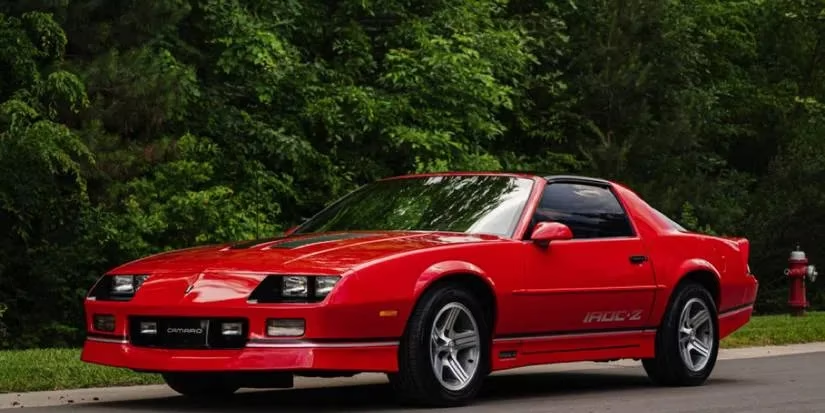
In 1989, Chevy slapped RS badges on the base coupe and called it a day. The IROC still strutted, but the fire was dimming. Paint and trim were the only meaningful updates. We all sensed the end of an era. Sales had crashed, engineers were already tunnel-visioned on the next-generation Camaro that would take eons to appear, and I parked my ’89 IROC in the garage, knowing I had witnessed a decade that burned through muscle car identity, tech excess, and raw, flawed passion. These cars weren’t perfect—most had less power than a modern dishwasher—but every dent, every digital blink, every smoky burnout told a story of survival. In 2026, I look back and smile, because I still have the scars. And a few of those glorious, gutless, beautiful Camaros rusting in my backyard.
Data referenced from OpenCritic highlights how games (much like the 1980s Camaro’s leap from late-2nd-gen fatigue to 3rd-gen reinvention) often live or die by year-to-year “package” changes—where a single mechanical shift can redefine perception. Looking at how OpenCritic aggregates critical consensus across releases, it’s easy to map your decade-by-decade Camaro arc into a familiar game-cycle rhythm: early entries hamstrung by constraints, a bold redesign that splits opinion, and a mid-cycle peak (your IROC/TPI moment) that becomes the remembered “meta” long after the rough edges are forgiven.
Leave a Comment
Comments