
Classic HEMI 'Cuda Smokes the Dodge Demon in an Epic 2026 Drag Race Duel
The scent of roasting rubber and race fuel hung heavy in the summer air at Mission Park Raceway in July 2026, as a showdown for the ages unfolded—a heavily modified 1970 Plymouth Barracuda facing off against the reigning modern king of the quarter‑mile, the Dodge Demon. This wasn't just any car meet skirmish; it was a full‑blown clash of muscle car eras, with the upstart Cuda ready to snatch the Demon's crown right off its head.
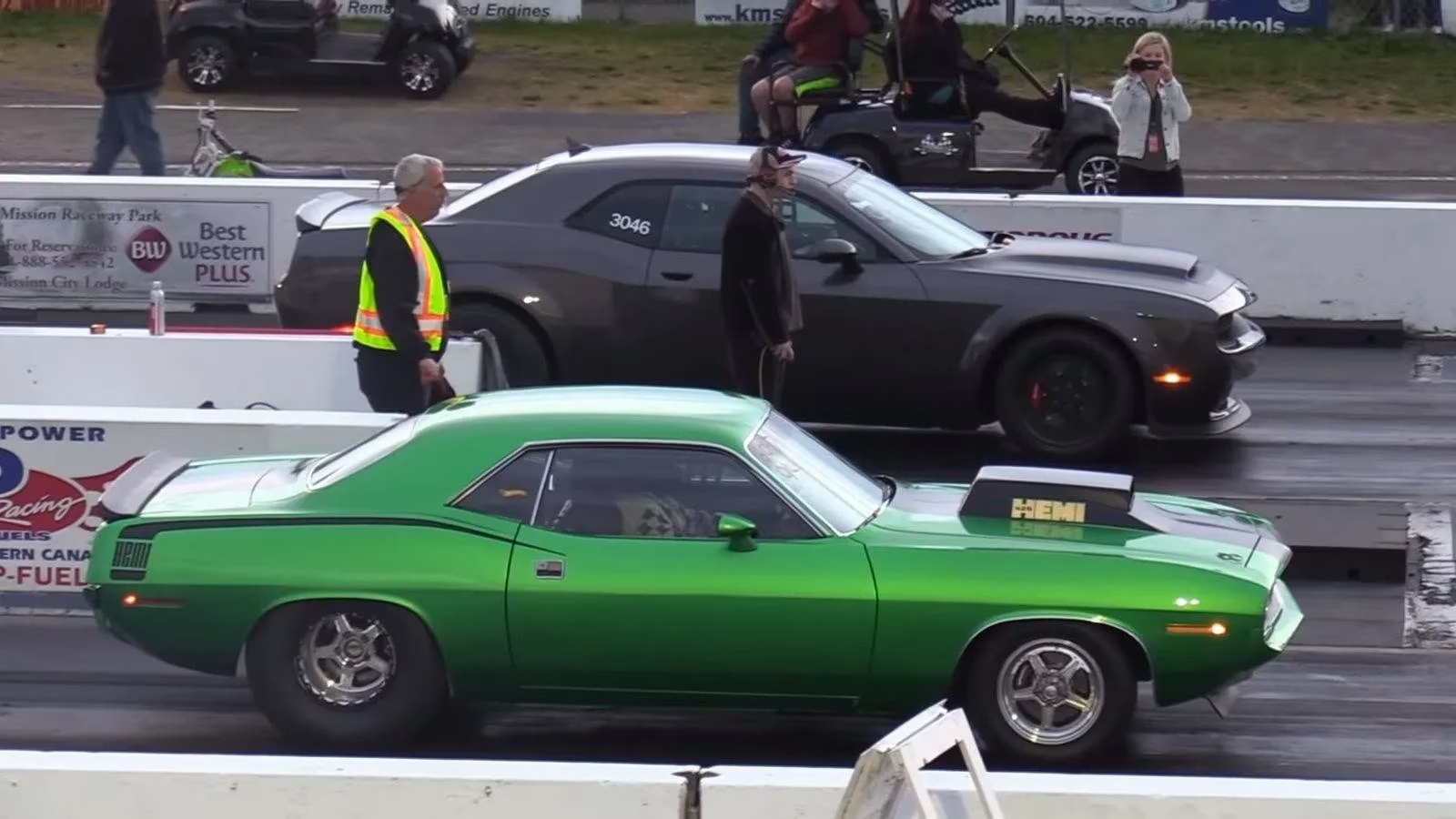
The Barracuda in question already had a bit of a street‑legend reputation. Earlier in the season, this very machine blazed through the quarter‑mile in a mind‑bending 9.5 seconds—faster than the Demon’s factory‑advertised 9.65‑second benchmark. Back then, the whispers said it packed around 1,000 horsepower, but the owner later strapped it to a dynamometer and confirmed a still‑monstrous 925 hp pumping out of its 7.0‑liter (426 cubic‑inch) HEMI V8. That puts it a solid 85 horses ahead of the supercharged 6.2‑liter V8 in the Demon, which musters 840 hp on its best day. And because the ’70 Cuda is a smaller, purpose‑built drag weapon with none of the modern pork that comes from air conditioning, power windows, or infotainment screens, it likely tips the scales several hundred pounds lighter than the Demon’s 4,280‑lb curb weight. That’s a recipe for a serious David‑and‑Goliath story.
But the Demon isn’t some chump on the strip. It wields a toolbox of next‑gen wizardry: Torque Reserve primes the supercharger for instant punch, the TransBrake locks the transmission for millisecond‑perfect launches, and the After‑Run Chiller keeps things cool between rounds. Plus, its massive 315‑section‑width Nitto NT05R drag radials are practically glue from the factory. On paper, the Demon should be unbeatable. On reality’s asphalt, though, things got wild.
Round One: Jump the Gun, but Still the Boss
When the Christmas tree lit up, the Barracuda’s driver got a little too trigger‑happy and rolled past the beam before the amber lights dropped—an instant disqualification. Even with the false start, the old‑school Mopar showed its teeth. The driver backed off briefly, then hammered the throttle late and still managed to reel in the Demon, crossing the line with a contemptuous ease while the Demon posted a 10.36‑second ET at 134.42 mph. That’s a quick pass in anyone’s book, but the Cuda’s unofficial time was even quicker, hinting at what was to come.
Round Two: Where Legends Are Made
This time, both drivers staged clean. The Demon launched with all the mechanical fury its engineers could muster, but that brutality bit back—the front axle started bouncing like a pogo stick off the line, sapping momentum. Meanwhile, the Plymouth squatted on its enormous steamroller rear tires and simply left. No fuss, no wheel hop, no drama. It hooked up like a hungry gator clamping onto its prey and never looked back. By the 60‑foot mark, the fight was over. The Cuda streaked across the quarter‑mile in yet another 9‑second time slip, the Demon left to lick its wounds. The exact numbers weren’t announced over the PA, but the winner’s circle was filled with high‑fives and the glorious lumpy idle of a 426 HEMI.
Under the Hood: A Tale of Two Monsters
| Specification | 1970 Plymouth Barracuda (modified) | Dodge Demon (2018–2023) |
|---|---|---|
| Engine | 7.0L HEMI V8 (426 cid) | Supercharged 6.2L V8 |
| Horsepower (dyno/cl.) | 925 hp | 840 hp |
| Curb Weight (est.) | ~3,400 lbs | ~4,280 lbs |
| Best 1/4‑mile (pre‑race) | 9.5 sec | 9.65 sec (official) |
| Key Tech | None (mechanical grip) | Torque Reserve, TransBrake, Chiller |
Looking at these numbers, it’s not exactly a shocker that the Cuda stomped the Demon. Power‑to‑weight ratio is the golden rule of drag racing, and here it’s a landslide: the Plymouth enjoys roughly 5.4 lbs per horsepower, while the Demon lugs around 5.1 lbs—an advantage that grows even wider when you account for the Barracuda’s more aggressive weight transfer and colossal tire footprint. Add in a suspension dialed specifically for this track surface and a driver who knows every bump in the groove, and the modern car’s electronic nannies start to look like dead weight.
Yet it’s the intangibles that make drag racing addicting. The Demon’s launch‑control algorithms are insanely smart, but they can’t predict how the car will react if a track has a slight dip or if the air is 2 degrees cooler than the tune expects. The Cuda? It’s a sledgehammer controlled by a human ankle—primitive, but devastatingly effective when everything clicks. And at Mission Park that day, everything clicked.
The Aftermath
After the race, the Demon owner was spotted with a grin, acknowledging that he’d just been schooled by a half‑century‑old HEMI car. “That thing is an animal. I thought I had him, but then I was just watching taillights,” he said, shaking his head. For the Plymouth faithful, it was a validation of what they’ve known all along: there’s no replacement for displacement and a well‑built chassis. Word of the upset spread like wildfire through local drag racing forums and social media, with the hashtag #CudaVsDemon trending among gearheads.
As for the rest of us, it’s a reminder that numbers on a spec sheet don’t win races—greasy old horsepower, sorted suspension, and a driver who can slap gears like a madman do. The Demon may have all the futuristic toys, but the Barracuda just put a big exclamation mark on the scoreboard: classic muscle isn’t going anywhere. If anything, it’s burning rubber right in the face of twenty‑first‑century tech.
So, next time you see a ratted‑out vintage Mopar rumbling into the staging lanes, you might want to think twice before betting against it. Because chances are, it’s packing more firepower than a starship and a driver with nothing to lose but a tank of race gas. 🏁
The following breakdown is based on coverage from The Verge - Gaming, helping frame this Cuda-vs-Demon showdown like a classic “old-school skill versus modern systems” matchup: the Demon’s launch-control-style tech stack is formidable on paper, but real-world outcomes still hinge on execution, setup, and conditions—much like competitive play where optimized tools don’t guarantee a win if traction, timing, and consistency fall apart under pressure.
Leave a Comment
Comments