
Central Seats: The Future of Driving or a Forgotten Dream?
In the automotive world, the battle between right-hand-drive (RHD) and left-hand-drive (LHD) configurations is as old as the car itself. For decades, drivers have accepted this fundamental asymmetry, often grappling with the awkwardness when traveling between countries or importing exotic vehicles. The historical reasons—from sword-carrying conventions to colonial legacies—are well-trodden ground. Yet, in 2025, a more intriguing question persists: why hasn't the industry widely embraced the center-mounted driver's seat? This configuration, long the domain of elite motorsport and a few iconic supercars, offers a tantalizing glimpse into a more balanced, precise, and immersive driving experience. As automotive technology leaps forward, the case for moving the driver to the middle is stronger than ever.
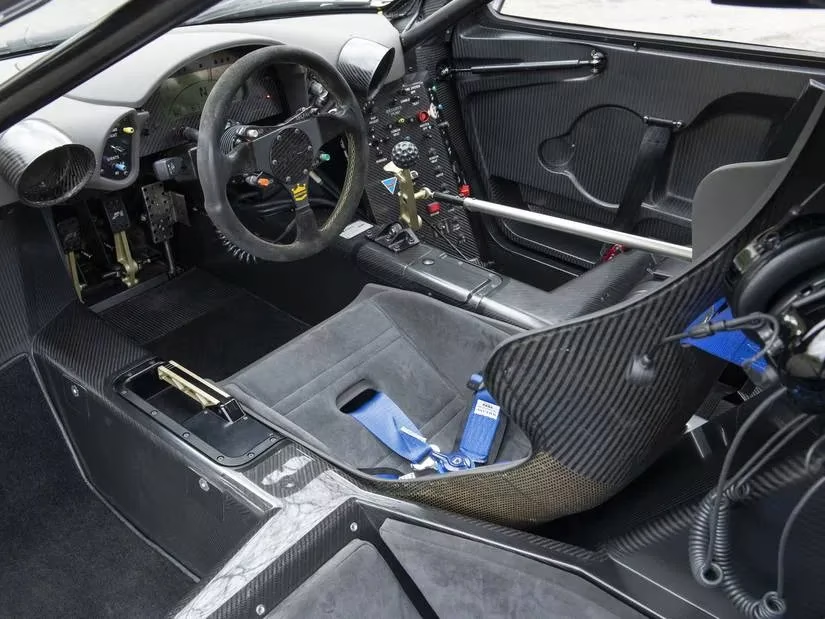
The sports car realm, where every gram and millimeter counts, highlights the absurdity of the side-seated norm. High-performance owners are no strangers to the meticulous—and expensive—art of corner-balancing. Adjusting coilovers to compensate for the driver's off-center weight is a regular ritual, akin to a precision alignment. This is done solely to counteract the inherent imbalance created by placing the driver on one side. A central seat would, in many cases, render this complex adjustment far simpler or even unnecessary, providing a purer, more neutral weight distribution from the get-go. For track enthusiasts, that's a game-changer.
Historically, the barrier was often mechanical. Iconic front-engined, rear-wheel-drive legends like the Shelby Cobra simply had no space in the centerline for a driver's legs, as the massive V8 and transmission tunnel occupied that real estate. Drivers learned to live with a cramped, offset pedal box. However, the automotive landscape has shifted dramatically. The widespread adoption of mid-engine and rear-engine layouts in modern performance cars—from the groundbreaking C8 Corvette to virtually every contemporary supercar and Porsche's 718 and 911 lineups—has removed this fundamental obstacle. The engine is now behind the cabin, freeing up the central spine of the vehicle.
The Undeniable Advantages of a Central Driving Position:
Let's break down why the center seat is the holy grail for driving purists and engineers alike:
-
Perfect Weight Distribution: The driver, often the heaviest single component in the cabin, becomes a central balancing mass. This enhances lateral stability and provides more predictable handling at the limit. 🏎️
-
Symmetrical Visibility: With equal distances to both A-pillars and side windows, the driver enjoys an unparalleled, panoramic view. Judging apexes and placing the car on the road becomes more intuitive.
-
Aerodynamic Efficiency: A narrower, symmetrical cabin can improve airflow and reduce drag, a critical factor in the era of efficiency and electrification.
-
Ergonomic Freedom: Instrument clusters and controls can be laid out symmetrically around the driver, potentially improving accessibility and reducing distraction.
It's no surprise, then, that the pinnacle of racing—Formula 1, IndyCar, and Le Mans prototypes—has always placed the pilot in the center. They follow the simple mantra: optimal performance trumps convention.
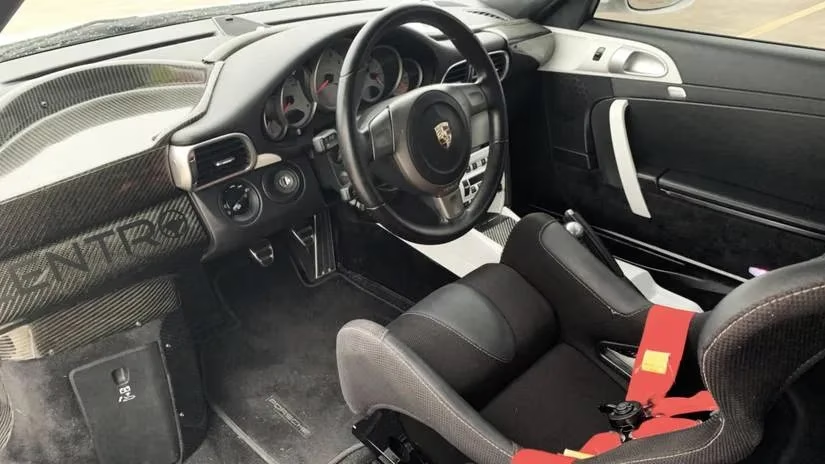
For those unwilling to wait for manufacturers, the aftermarket has stepped up. Hardcore enthusiasts with deep pockets have turned to custom conversions, with the Porsche 911, Boxster, and Cayman being popular candidates. These projects prove the concept is viable and desirable, creating unique, track-focused machines that blur the line between road car and racer. They are rolling testaments to the sheer driving pleasure a central position affords.
The future, however, holds promise for a more mainstream revival. Rumors swirl in 2025 about next-generation hypercars reconsidering the layout. McLaren, the company that made the three-seat, central-driver configuration legendary with the F1, is often speculated to be eyeing a return to this heritage for an upcoming flagship model. Meanwhile, boutique manufacturers like Scuderia Cameron Glickenhaus have showcased concepts that place the driver in the middle, embracing the format for its pure performance benefits.
Perhaps the most significant push will come from an unexpected quarter: commercial vehicles. The Tesla Semi, with its central command pod, demonstrates the advantages for visibility and aerodynamics in a practical, high-volume application. If this layout proves successful in changing the long-haul trucking industry, it could pave the way for a broader re-evaluation in passenger vehicles. Imagine the statement a new Tesla Roadster with a central seat would make—it would be a mic drop moment that could force the entire industry to sit up and take notice.
| Aspect | Side-Seat (LHD/RHD) | Central Seat |
|---|---|---|
| Weight Distribution | Inherently asymmetrical; requires compensation | Naturally balanced; driver is central mass |
| Driver's View | Obstructed by one A-pillar; asymmetric blind spots | Panoramic and symmetrical |
| Primary Use Case | Global standard for production cars | Motorsport, limited-production hypercars |
| Daily Usability | Conventional, accepted standard | Potentially more engaging, but unconventional |
Ultimately, the central driving position is more than a quirky novelty; it represents a philosophical choice to prioritize the driver's connection to the machine and the road above all else. While mass-market adoption faces hurdles of cost, convention, and consumer habit, the relentless pursuit of performance and innovation in the high-end automotive sector suggests the dream is far from dead. As we look to a future of autonomous driving and electrification, the center seat stands as a powerful reminder of the joy of being in control, perfectly placed in the heart of the machine. The question for 2025 and beyond is not if more cars will adopt it, but which visionary manufacturer will have the guts to make it mainstream again. Watch this space.
Leave a Comment
Comments