
A Modern Demon Versus a Vintage Charger R/T: My 2026 Drag Strip Experience
I finally saw it with my own eyes last weekend at the drag strip—the kind of matchup that makes you forget about all the electric hypercar records and self-driving tech. Two icons, separated by nearly five decades, lined up under the Texas sun: a 2018 Dodge Demon and a carefully massaged 1970 Charger R/T. The moment those staging lights began to blink, my heart was already pounding harder than a dual-disc clutch on a clutch dump.
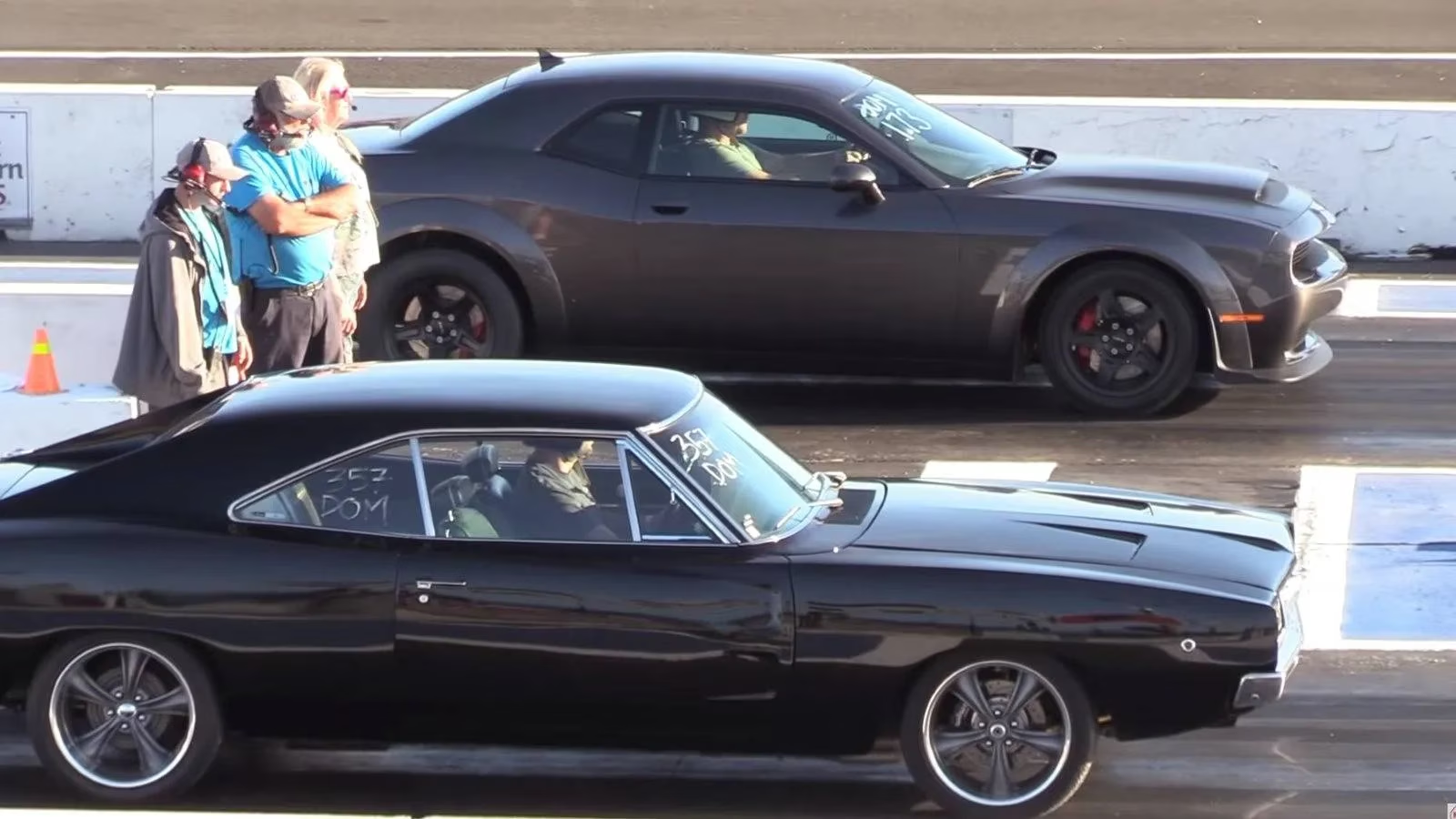
Now, I need to give some context. The Demon is a known monster. Even in 2026, eight years after it first terrorized streets and strips, it still holds a mythical status. Under that hood sits a 6.2-liter supercharged HEMI V8 that, on 100-octane juice, pumps out 840 horsepower and 770 lb-ft of torque. Zero to 60 mph? Mid-2-second range. Quarter-mile times? Officially Dodge claimed 9.65 seconds, though anyone who’s been to the track knows that real-world runs almost always hang in the low 10s. It’s a factory freak that weighs around 4,300 lbs but launches like a startled rhino.
The old Charger, though? That’s where things got spicy. In stock form, a 1970 Charger R/T came with a 7.2-liter Magnum V8 pushing 390 hp and 480 lb-ft—legendary numbers for the Nixon era but laughable against the Demon’s output. And with only a 3-speed or 4-speed manual, shifting would eat up precious ticks of the clock. But this wasn’t a stock Charger. I spotted the telltale Wilwood calipers on the front wheels, bright red against the black steelies. That car had been breathing hard on some modern go-fast parts. Rumor in the pits said it might have been one of the early recipients of the 1,000-hp Hellephant crate engine that Dodge Performance rolled out a few years back, but nobody would confirm or pop the hood for me.
With its stripped interior and fiberglass hood, the Charger tipped the scales at roughly 3,700 lbs, giving it a significant weight advantage over the Demon. Still, making that power stick to the pavement with old-school suspension and manual shifting sounded like a wrestling match with physics.
🔥 The Moment of Truth
Both drivers did their burnouts. The Demon’s was a clean, 2-second haze of tire smoke and a supercharger whine that could wake the dead. The Charger… well, it fought the clutch a bit, the rear end squirming before it finally hooked. They staged. The tree dropped.
The Demon launched with a bizarre lack of drama—barely a squeal from the Nitto drag radials, just a deep, guttural roar and a forward surge that looked like a video on fast-forward. The Charger’s nose lifted, the big block barking through open headers, but the 60-foot time told the story. The Demon was already a car length ahead and pulling relentlessly. By the 1/8th mile, the distance had stretched to several lengths. When the timing boards lit up, the Demon had run a stunning 10.02 seconds at 134.73 mph—one of the quickest passes I’ve ever personally witnessed from a stock-blown HEMI. The Charger crossed at 12.82 seconds at 113.99 mph, which, for a manual-shift ‘70s machine, is still deeply respectable.
Yet, there was no close battle. Modern technology, with its launch control, quick-shifting 8-speed automatic, and supercharger efficiency, simply overwhelmed the old-school charm. I jotted down some quick notes on my phone to compare the specs later:
| Spec | 1970 Charger R/T (Modified) | 2018 Dodge Demon |
|---|---|---|
| Engine | 7.2L V8 (likely built) | 6.2L Supercharged HEMI |
| Horsepower | ~390 hp (stock) – possibly 1,000 hp? | 840 hp (100-octane) |
| Torque | 480 lb-ft (stock) | 770 lb-ft |
| Transmission | 4-speed manual | 8-speed automatic |
| Curb Weight | ~3,700 lbs | ~4,300 lbs |
| Quarter-Mile | 12.82s @ 113.99 mph | 10.02s @ 134.73 mph |
💭 Post-Race Reflections
Walking back through the pits, I couldn’t help but feel a mix of awe and nostalgia. The Demon is a masterpiece of engineering that remains relevant even in the hybrid-hypercar era of 2026. But seeing that Charger, all raw edge and analog fury, made me realize why we still flock to these events. It doesn’t have to win to steal the show.
And honestly? If that Charger really is hiding a 1,000-hp Hellephant under the hood, the gap should shrink dramatically once the owner figures out traction and modern suspension geometry. I’ve seen Hellephant-swapped B-bodies run high 9s with proper setup. Maybe next year I’ll be back here, watching a rematch where old-school muscle finally gets its revenge. Until then, I’m just glad I got to see two very different definitions of horsepower tear up the asphalt on the same sunny afternoon.
They say the Demon is the king of the quarter, but the Charger R/T is the emperor of our hearts. ⚡👑
Leave a Comment
Comments