
2023 Dodge Hornet's TFL Slip Test Nightmare
The Fast Lane (TFL) YouTube channel has built its reputation on rigorous, no-nonsense testing of pickup trucks and SUVs, cutting through manufacturer hype to deliver unfiltered truths to consumers. Their demanding track evaluations are designed to expose potential flaws before buyers commit. When Tommy, a familiar face from TFL known for his candid reviews, got behind the wheel of a pre-production 2023 Dodge Hornet in a striking white finish with gloss black wheels, expectations were high for Dodge's new compact SUV. Initial impressions were promising, but the true test lay ahead on TFL's infamous slip pads, designed to simulate challenging traction scenarios. 😬

Initial Testing Success: A False Sense of Security?
The evaluation commenced with promising results:
-
Single Wheel Slip Test: The Hornet performed admirably. When only one wheel lost traction on the slip pad, the vehicle's systems engaged promptly, pulling it free without hesitation. Tommy repeated the test multiple times for consistency, and the Hornet passed each attempt smoothly.
-
Diagonal Slip Test: Moving to a more complex scenario where diagonally opposite wheels lost traction, the Dodge SUV continued to impress. While a slight hesitation was noted, a quick application of throttle was sufficient for the vehicle to regain control and drive off the pads effectively.
These early successes suggested a competent all-wheel-drive system. But what happens when pushed to an even more extreme limit?
The Three-Wheel Test: Where Things Went Spectacularly Wrong 🔥
The critical phase arrived: the three-wheel slip test. In this demanding setup, only one wheel retains full traction, while the other three are rendered useless on the slip pads. This is the ultimate stress test for a vehicle's traction control and drivetrain systems. Tommy initiated the test, applied power, and... chaos ensued.
Instead of valiantly struggling for grip, the 2023 Dodge Hornet's dashboard erupted in a blinding array of warning lights and error messages. The sheer volume of alerts was overwhelming, likened to a festive Christmas tree display. Simultaneously, a cacophony of warning chimes filled the cabin.
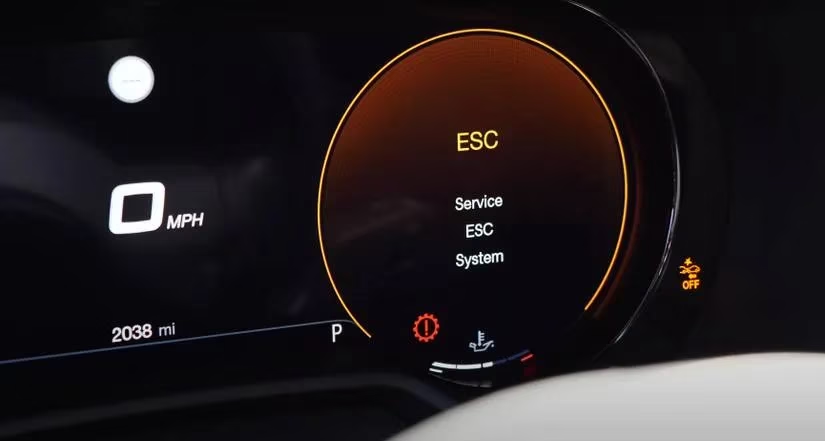
Tommy's reaction shifted from shock to visible frustration. His face reportedly mirrored the Hornet's white paint before flushing a deep red. Faced with a vehicle essentially crippled by its own electronics, he embarked on a series of troubleshooting attempts:
-
Resetting Procedures: Standard reset protocols were followed meticulously.
-
Battery Disconnect: The battery was disconnected in an attempt to force a full system reboot.
-
Extended Driving: The vehicle was driven for a period, hoping the systems would self-correct.
While these efforts managed to extinguish most of the glaring warning lights, one stubborn and critical alert refused to disappear: the persistent "Check Engine" light. Faced with this unresolved major fault indicator and the potential risk of causing further damage, Tommy wisely concluded the test and returned the malfunctioning pre-production Hornet to Dodge. The test was a failure.
The Underlying Concern: The Alfa Romeo Connection ⚠️
This incident raised significant questions about the Hornet's underlying engineering. The 2023 Dodge Hornet is manufactured in Italy on the exact same production line as the Alfa Romeo Tonale. The two vehicles share fundamental components, including their entire drivetrain and the 2.0-liter turbocharged four-cylinder engine. Could the Hornet's dramatic failure be a symptom of the historically perceived poor reliability associated with certain Italian automotive electronics?
Dodge, understandably concerned by the very public failure, swiftly assured TFL that the issues encountered were exclusively related to the pre-production status of that specific vehicle. They emphasized that such problems would not be present in customer-bound models. However, the incident served as a stark reminder of the value of independent testing. Why rely solely on manufacturer assurances when real-world stress tests exist? TFL's slip test provided a crucial, albeit alarming, data point for potential buyers. As the Hornet entered the market in 2023, early adopters certainly kept a watchful eye for any recurrence of these electrical gremlins, hoping Dodge's assurances held true. Looking back from 2025, the incident remains a notable chapter in the Hornet's launch story, highlighting the critical role of third-party evaluators like TFL in the modern automotive landscape.
Leave a Comment
Comments